Body Basics
The lymphatic system, explained
It has no pump of its own, it carries roughly twice the volume of blood, and most people never think about it. A plain-language look at how the body moves fluid.

Ask most people to name the systems that keep the body running and you will hear about the heart, the lungs, maybe the gut. The lymphatic system rarely comes up. Yet it runs through nearly every part of the body, and it handles a job the others cannot: managing the fluid that sits between cells.
What it actually does
The lymphatic system is a network of thin vessels, hundreds of small nodes, and organs including the spleen and thymus. Blood capillaries constantly leak a small amount of fluid into surrounding tissue. Most of it returns to the bloodstream on its own. The remainder, roughly a few litres a day in an average adult, is collected by lymphatic vessels, filtered through the nodes, and returned to circulation near the collarbone.
That fluid, once collected, is called lymph. Along the way it carries immune cells, which is why the system is as much a part of immune defence as it is of fluid balance. Swollen nodes during an infection are the visible side of that work.
The heart pumps blood. Nothing pumps lymph — the system depends on the movement of the body around it.
The system without a pump
This is the detail that surprises people. Lymphatic vessels have one-way valves, and the fluid inside them advances when surrounding structures squeeze: skeletal muscle contracting during walking, the diaphragm moving with each breath, the rhythmic tone of the vessel walls themselves. Gravity works against the process in the lower body, which is one reason long periods of sitting or standing still are often discussed in this context.

Habits commonly discussed
General wellness guidance tends to converge on a short and unglamorous list. None of it is specific to any one product or protocol:
- Moving regularly. Walking, stretching and simply standing up through the day keep skeletal muscle engaged.
- Breathing deeply. Diaphragmatic breathing is frequently mentioned because of the pressure changes it creates in the trunk.
- Staying hydrated. Fluid balance is, at its simplest, a question of what comes in and what moves through.
- Sleeping consistently. Recovery processes across the body are tied to regular, sufficient sleep.
- Elevating the legs. A common comfort measure after long periods on your feet, and one that works with gravity rather than against it.
These are general lifestyle habits, not treatments, and individual circumstances differ widely.
When to speak to a professional
Persistent or one-sided swelling, swelling that appears suddenly, skin changes, pain, or shortness of breath are reasons to contact a qualified healthcare provider rather than to self-manage. A clinician can identify causes that lifestyle measures do not address.
Why it gets so little attention
Partly because it is hard to see. Blood pressure has a number; lymphatic function, for most healthy people, does not. Partly because the language around it has been crowded by marketing claims that outrun the evidence. The underlying anatomy, though, is settled and unremarkable: a drainage network that works quietly, mostly in response to how much the body moves.
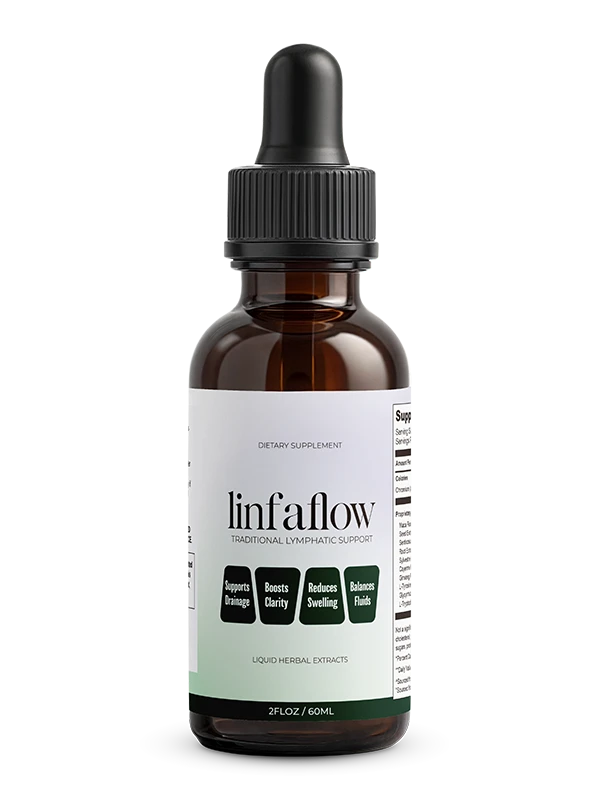
Linfaflow®
A liquid blend of four traditional botanicals — Cleavers, Stillingia Root, Red Clover and Prickly Ash Bark — formulated to support the body's natural lymphatic flow and fluid balance, taken as drops once or twice daily.
This section is advertising. Inner Health Journal published this article in partnership with Linfaflow, which paid for its placement. Linfaflow is a dietary supplement, not a medicine, and is intended for adults. These statements have not been evaluated by the Food and Drug Administration. This product is not intended to diagnose, treat, cure or prevent any disease.
The editorial portion of this article is published for general information only. It is not medical advice, and it is not intended to diagnose, treat, cure or prevent any disease. Speak with a qualified healthcare professional about your individual circumstances before making changes to your routine.
About Inner Health Journal. We publish plain-language explainers on how the body works, written by our editorial team and reviewed for clarity and accuracy. Articles produced with a commercial partner are labelled as partner content, and any advertising section is marked as such — our explainers are written independently of it. Questions or corrections can be sent through our contact page.